

Mamie Jones’s Cleveland County Early Days newspaper column, originally published in The Shelby Star, documents everyday life, cultural practices, transportation, industry, and notable residents of Cleveland County, North Carolina. The column reflects both documented history and memory-based storytelling, featuring personal recollections, oral traditions, biographies, and accounts of community events.
The clippings in this collection vary in condition; some issues are undated, partially damaged, or incomplete. Articles in the collection reflect the historical context and language conventions of the period in which it was written. Some terminology and descriptions used in the text may be outdated or considered inappropriate by modern standards. These materials are presented for research and educational purposes to preserve the historical record and to support understanding of past perspectives, social conditions, and cultural attitudes.








-
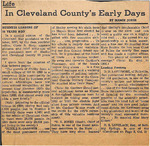
Undated (01) - Cleveland County Early Days
Mamie Jones
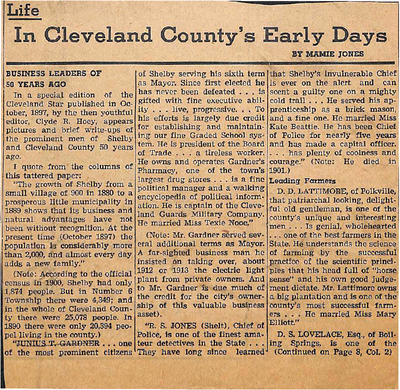
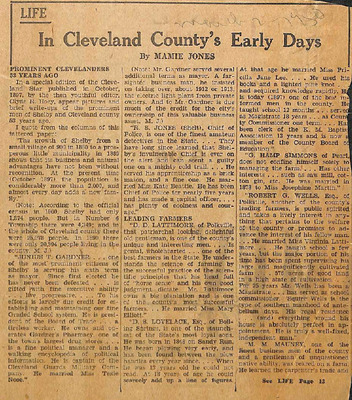
This article draws from an 1897 special edition of The Cleveland Star to profile prominent business leaders, farmers, and civic figures in Shelby and Cleveland County. It highlights individuals such as Mayor Junius T. Gardner, Police Chief R. S. Jones, and successful farmers and entrepreneurs, emphasizing their achievements, leadership, and contributions to community growth. The piece also reflects on Shelby’s population expansion and economic development during the late 19th century.
-
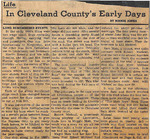
Undated (02) - Cleveland County Early Days
Mamie Jones
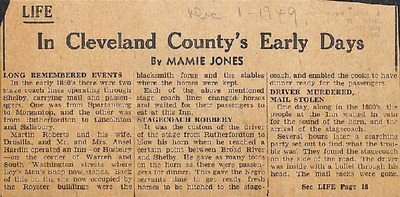
This article recounts notable events in Cleveland County from the 1860s through the Spanish-American War era. It describes stagecoach travel through Shelby, including a robbery and murder of a driver, and the sensational 1891 trial of the Motz brothers for the accidental killing of their cousin while attempting revenge on Robert Michael. The narrative also covers community reactions to the verdict and local participation in the Spanish-American War, including the Cleveland Guards’ service and the death of soldier Robert Justice from illness.
-
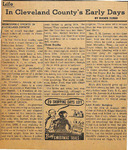
Undated (03) - Cleveland County Early Days
Mamie Jones
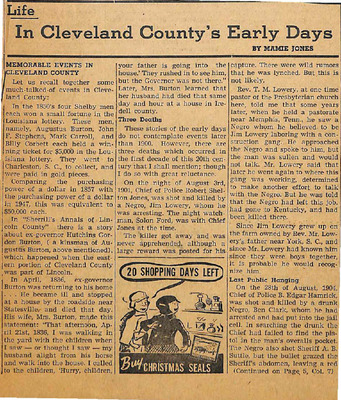
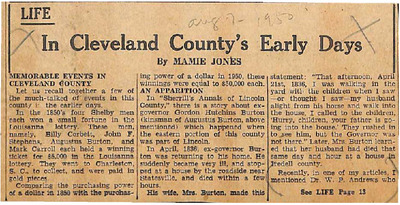
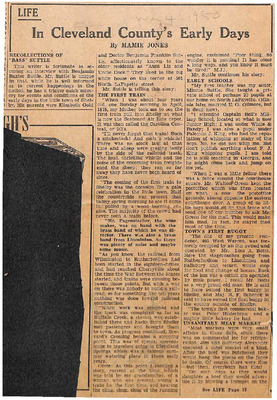
This article recalls several memorable incidents in Cleveland County during the 19th and early 20th centuries. It includes stories of Shelby residents winning the Louisiana lottery in the 1850s, the death of former Governor Augustus Burton in 1836, and violent events involving local law enforcement in the early 1900s, including the killings of Police Chiefs Robert Shelton Jones and B. Edgar Hamrick. It also recounts the county’s last public hanging and a 1909 roadside confrontation near Fallston involving Dr. T. B. McBrayer and a man named Walker.
-
Undated (04) - Cleveland County Early Days
Mamie Jones
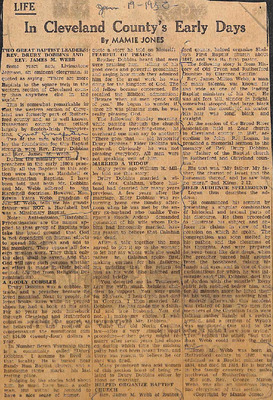
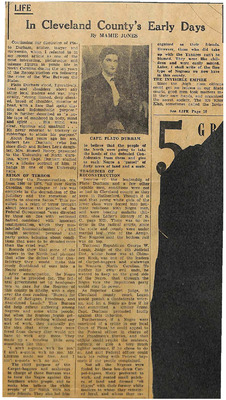
This article presents a biography of Captain Plato Durham (1840–1875), highlighting his Civil War service, legal career, and political leadership during Reconstruction in North Carolina. It describes his role as a conservative leader in the 1868 constitutional convention and legislature, his advocacy for citizens accused of Ku Klux Klan involvement, and his efforts to secure amnesty for indicted men. The piece also recounts his military service, family life, and early death from pneumonia.
-
Undated (05) - Cleveland County Early Days
Mamie Jones
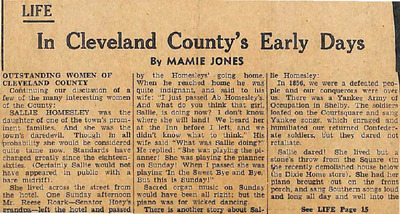
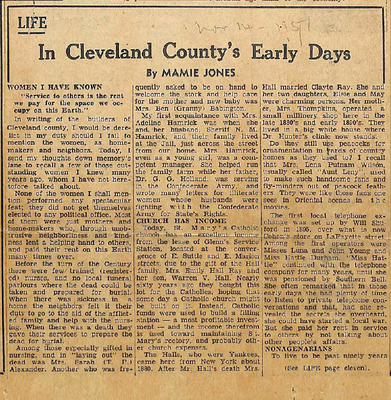
This article highlights notable women of Cleveland County, focusing on figures such as Sallie Homesley, during the Civil War era, and Mrs. Jane Marks, an early educator who helped establish religious instruction and schooling in Shelby. It also profiles musical talents like Lillian Homesley Bott and Minnie Eddins Roberts, along with mothers whose sons achieved literary prominence, including those connected to authors Thomas Dixon Jr., Wilbur J. Cash, and Hatcher Hughes.
-
Undated (06) - Cleveland County Early Days
Mamie Jones
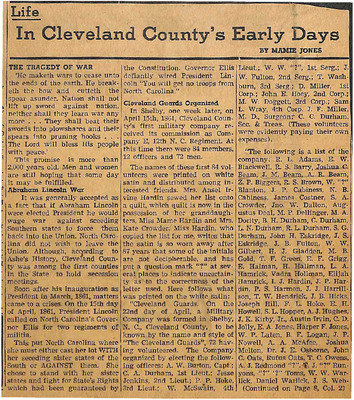
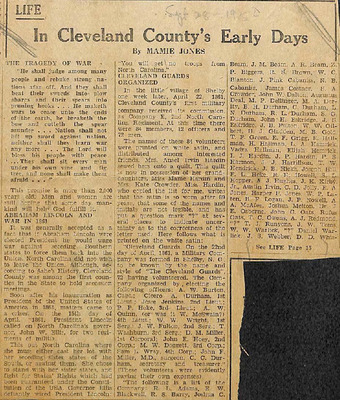
This article describes Cleveland County’s experience during the Civil War, focusing on the formation of the Cleveland Guards, the county’s first military company organized in Shelby in April 1861. It lists officers and volunteers, recounts how local women created and presented a silk Confederate flag, and tells how the banner was later captured by a Boston regiment and eventually returned after the war.
-
Undated (07) - Cleveland County Early Days
Mamie Jones
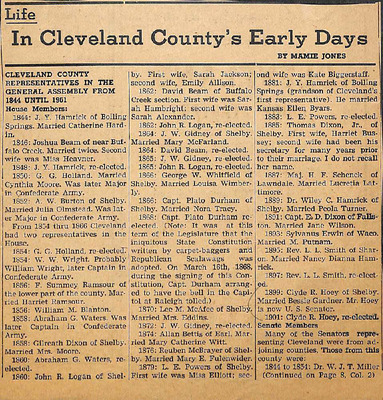
This article lists Cleveland County representatives and senators who served in the North Carolina General Assembly from 1844 through 1901, including biographical notes such as marriages, military service, and community ties.
-
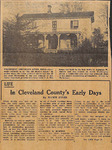
Undated (08) - Cleveland County Early Days
Mamie Jones
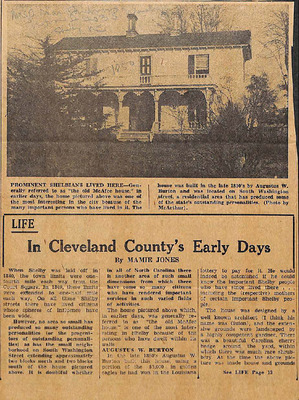
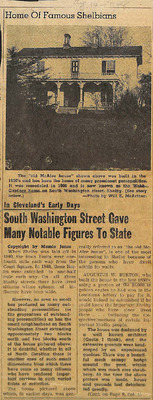
This article explores the history of prominent residents along South Washington Street in Shelby, particularly the house originally built in the late 1850s by Augustus W. Burton, often called the “old McAfee house.” It traces the succession of notable occupants—including the Roark, McAfee, Anthony, Webb, and Gardner families—and highlights their political, religious, educational, and civic contributions to North Carolina. The home was later locally known as “Webbley” or the O. Max Gardner House. The article also connects nearby homes and residents, such as the Dixon and Durham families.
-
Undated (09) - Cleveland County Early Days
Mamie Jones
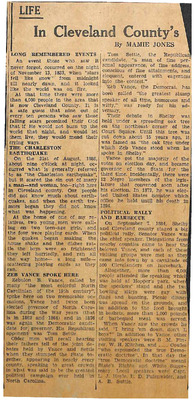
This article recalls memorable events in Cleveland County history, including the 1833 meteor shower remembered as “stars falling,” the 1886 Charleston earthquake felt locally, and major political gatherings featuring Governor Zebulon B. Vance and opponent Tom Settle. It describes campaign debates held near Shelby’s courthouse square and a large 1884 political rally with thousands attending speeches and a community barbecue at Hopper’s Park.
-
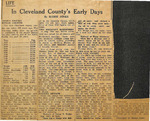
Undated (10) - Cleveland County Early Days
Mamie Jones
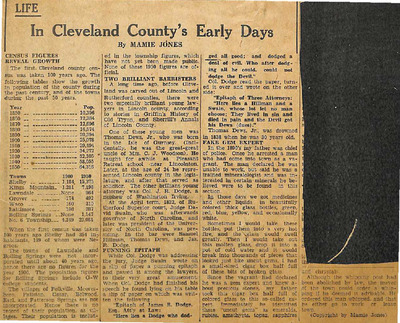
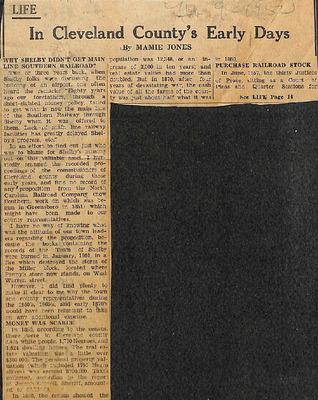
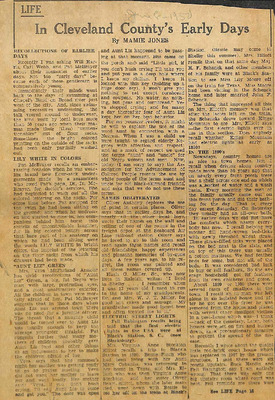
This article combines historical data and local anecdotes to illustrate life in Cleveland County across the 19th and early 20th centuries. It presents census figures showing population growth since 1850 and compares town populations over time. The narrative also includes stories of early lawyers in neighboring counties, humorous courtroom exchanges, and a late-1800s incident involving a supposed mineral expert exposed by colored glass mistaken for gems.
-
Undated (11) - Cleveland County Early Days
Mamie Jones
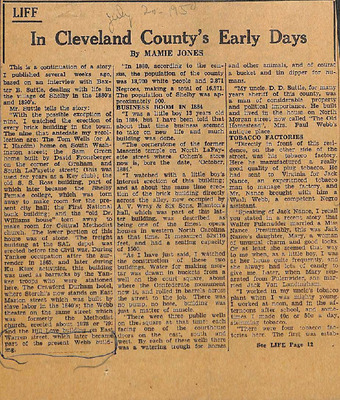
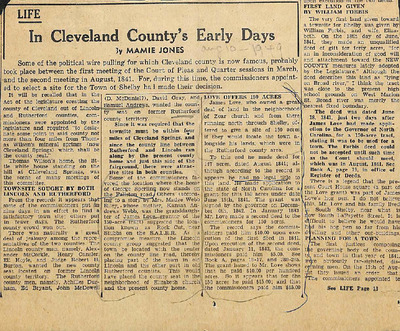
This article reflects on Cleveland County’s early development. It describes the town’s establishment in 1841, including land donations, street layouts, prison boundaries, and early families living near the courthouse square. Anecdotes recall buffalo sightings along Buffalo Creek and the arrival of Robinson’s Circus in the 1840s. The piece also highlights influential figures such as James Love and John R. Logan, whose civic contributions helped build local institutions.
-
Undated (12) - Cleveland County Early Days
Mamie Jones
This article highlights the early pioneer women who settled Cleveland County between 1760 and 1775, describing frontier life, primitive housing, food preparation, medicine, and domestic labor. It also recounts the Revolutionary War heroism of Susan Twitty, who helped defend Graham’s Fort during a Tory attack in 1780, later marrying John Miller.
-

Undated (13) - Cleveland County Early Days
Mamie Jones
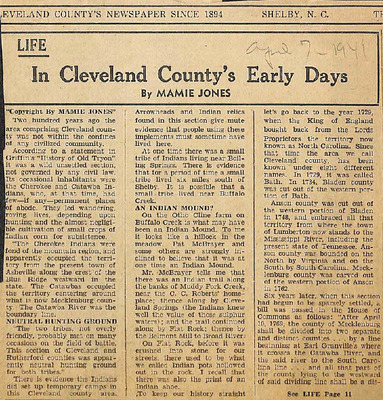
This article describes early settlement patterns in the region that later became Cleveland County, noting migration of Scotch-Irish and German immigrants. It explains the establishment of nearby county seats in Lincolnton and Rutherfordton and the role of ministers in founding churches and schools. The recounts the 1814 punishment of Arthur Clarke in Rutherford County.
-
Undated (14) - Cleveland County Early Days
Mamie Jones
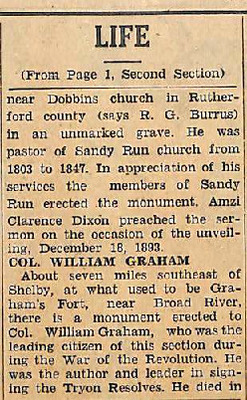
This article describes early pioneers of Number Three Township in Cleveland County, highlighting families such as the Grahams, Twitty’s, Blantons, Burchetts, Smiths, Suttles, and Doggetts. It includes biographical sketches of figures like Col. William Graham, Sheriff Charles Blanton, Drury Burchett, Minor Smith, and Rev. Drury Dobbins, emphasizing their roles in settlement, religion, and civic life. The narrative also traces Blanton family ancestry back to 18th-century migration and later banking leadership in Shelby.
-
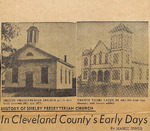
1954, April 22 - Cleveland County Early Days
Mamie Jones
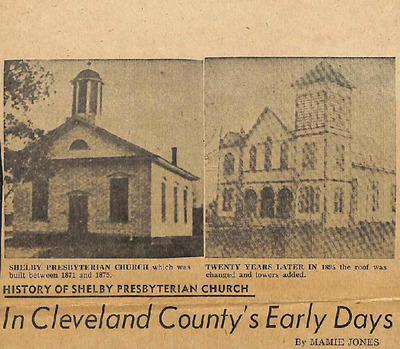
This article traces the history of Shelby Presbyterian Church from its organization in 1858 through the early 20th century. It describes the founding members, early worship in homes and other churches, and construction of the first church building completed in 1875. The narrative highlights hardships during the Civil War and Reconstruction, when only a few women sustained the congregation, and later growth under successive pastors. It also documents church leadership, expansions, and regional Presbyterian developments.
-
1953, July 30 - Cleveland County Early Days
Mamie Jones
This article continues the biography of Dr. Amzi Clarence Dixon, who became one of the most influential Baptist preachers of his era. It recounts his early religious experiences, education at Wake Forest, and rapid rise through pastorates in North Carolina, Baltimore, Brooklyn, Boston, Chicago, and London, along with international preaching and writing. The piece also describes his personality, strong convictions, marriages, and family background, including accomplished siblings such as physician Delia Dixon Carroll.
-
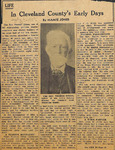
1953, July 9 - Cleveland County Early Days
Mamie Jones
This article profiles Rev. Thomas Dixon Sr., a prominent 19th-century Baptist minister whose preaching and leadership helped found New Prospect Baptist Church near Buffalo Creek in 1854. It recounts his revival preaching style, ministerial influence across Cleveland County, and his role in establishing numerous churches during a 65-year ministry. The piece also provides biographical details about his family, including his famous children, his early life in South Carolina, migration to Arkansas during the Civil War, and his later years in Shelby.
-

1952, April 13 - Cleveland County Early Days
Mamie Jones
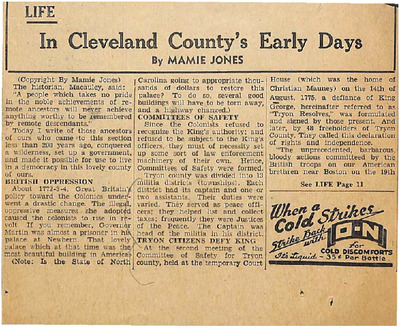
This article discusses Cleveland County during Reconstruction period in the 1870s, focusing on the rise and activities of the Ku Klux Klan and tensions involving Union League and Red Strings groups. It includes stories involving Capt. Plato Durham, a raid that resulted in the death of a Klansman, and the escape of Ned McBrayer. Later sections describe violent incidents, including the whipping of political opponents and arrests of local citizens by federal authorities.
-
1952, May 21 - Cleveland County Early Days
Mamie Jones
This article announces the dedication of the John R. Dover Memorial Library at Gardner-Webb Junior College in Boiling Springs and highlights John Randolph Dover’s contributions to Cleveland County as a leader in the textile industry, creating worker’s villages, building churches, and schools that shaped community development. The piece also briefly recounts his birth in 1858 near Beason’s Creek, South Carolina.
-
1952, October 9 - Cleveland County Early Days
Mamie Jones
This article traces the history of newspapers published in Shelby from the 1850s through the mid-20th century, highlighting early publications such as the Carolina Intelligencer, Mountain Eagle, and Shelby Aurora. It describes editors, ownership changes, political influences, and technological developments, including the evolution of The Cleveland Star into the Shelby Daily Star. Later sections mention additional local papers, short-lived publications, and specialized newspapers.
-
1951, April 19 - Cleveland County Early Days
Mamie Jones
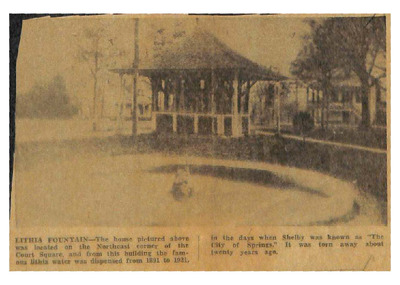
This article documents Cleveland County men who served as officers in Confederate regiments during the Civil War, listing companies, captains, lieutenants, and physicians connected to the Cleveland Guards and related units. It also includes postwar anecdotes, such as the story of J. M. Toms recovering a lost knapsack through correspondence with a former Union captain. Additional references describe former officers who later moved to the county and visitors drawn to Shelby’s lithia water.
-
1951, April - Cleveland County Early Days
Mamie Jones
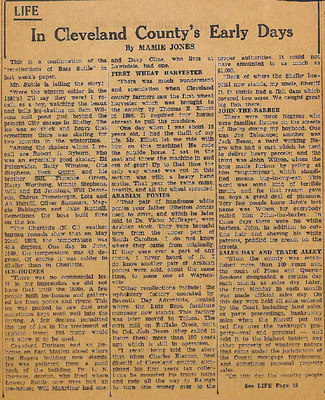
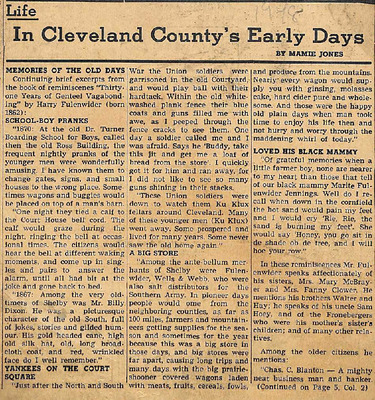
This article compares early agricultural practices in Cleveland County with modern methods, describing pioneer farming tools, cotton production, and the evolution of crop yields from the 1800s to the mid-20th century. It explains the development of cotton gins, the growing economic value of cottonseed, and the establishment of local oil mills. Additional sections discuss tobacco cultivation, primitive transportation of crops to markets before railroads, and regional wine production near Grover.
-
1951, August 3 - Cleveland County Early Days
Mamie Jones
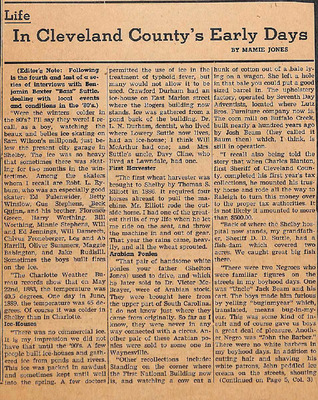
This article recounts the 1870 migration of Cleveland County families to Hunt County, Texas following the Civil War. It follows the Hardin family’s six-month wagon journey, including anecdotes such as Mrs. Hardin retrieving forgotten dentures and a mysterious horseback encounter later suspected to involve outlaw Jesse James. The piece also profiles Ansel Irvine Hardin as an inventor, public official, and prominent Shelby resident, describing his home, enslaved community members, and later events connected to the property.
-
1951, August 9 - Cleveland County Early Days
Mamie Jones
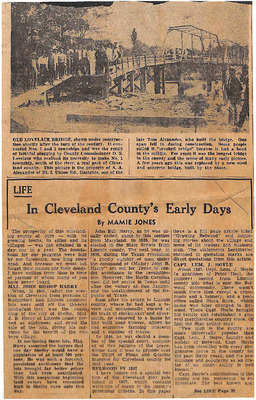
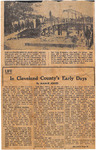
This article highlights early development in Cleveland County through biographies and community history centered on Major John Bishop Harry and Captain Lem J. Hoyle. It describes Harry’s role auctioning Shelby’s original town lots in 1841 and his later political and business career. The piece also traces the growth of the Belwood community, formerly Black Rock, including Hoyle’s store, public service, and leadership in establishing Belwood Institute, a preparatory school.
-
1951, February 1 - Cleveland County Early Days
Mamie Jones
This article focuses on the contributions of African Americans to Cleveland County from the end of slavery through the late 19th century. It emphasizes the physical labor that helped build Shelby and the county, the creation of Freedman communities, early churches, schools, and educators, and notable Black farmers, workers, and professionals. The narrative highlights institutions such as Compact School and Cleveland Training School, along with community leaders and educators who advanced opportunities despite limited resources. It concludes by noting African American participation in the Revolutionary War and honoring generations of hardworking individuals who shaped the county’s development.
This article reflects the historical context and language conventions of the period in which it was written. Some terminology and descriptions used in the text may be outdated or considered inappropriate by modern standards. These materials are presented for research and educational purposes to preserve the historical record and to support understanding of past perspectives, social conditions, and cultural attitudes. The inclusion of such language does not reflect current values or institutional positions but rather provides important insight into the time period in which the document was created.