

Mamie Jones’s Cleveland County Early Days newspaper column, originally published in The Shelby Star, documents everyday life, cultural practices, transportation, industry, and notable residents of Cleveland County, North Carolina. The column reflects both documented history and memory-based storytelling, featuring personal recollections, oral traditions, biographies, and accounts of community events.
The clippings in this collection vary in condition; some issues are undated, partially damaged, or incomplete. Articles in the collection reflect the historical context and language conventions of the period in which it was written. Some terminology and descriptions used in the text may be outdated or considered inappropriate by modern standards. These materials are presented for research and educational purposes to preserve the historical record and to support understanding of past perspectives, social conditions, and cultural attitudes.








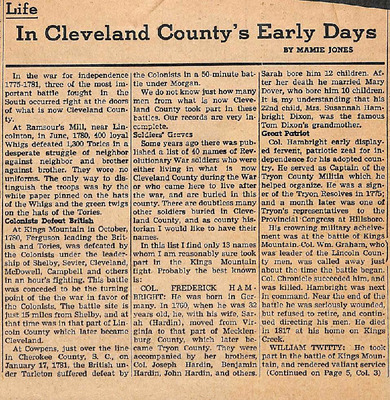
-
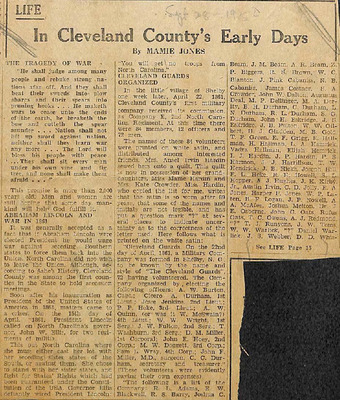
1950, September 28 - Cleveland County Early Days
Mamie Jones
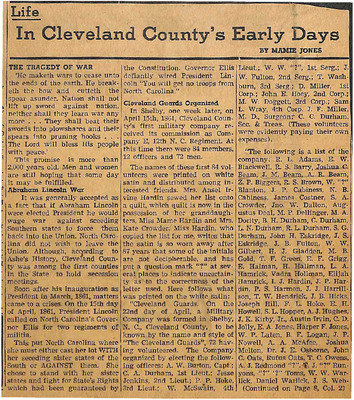
This article describes Civil War experiences in Cleveland County, focusing on the formation of the Cleveland Guards in Shelby in April 1861, the county’s response to secession, and the service of local soldiers in Confederate regiments.
-
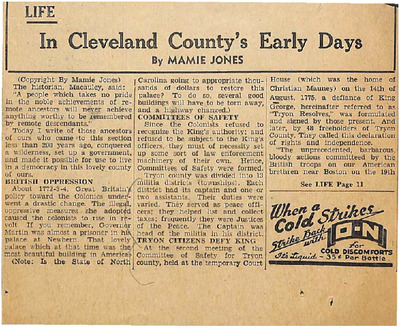
1949, April 14 - Cleveland County Early Days
Mamie Jones
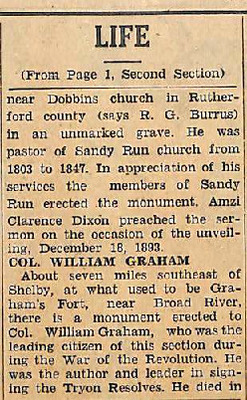
This article discusses the Revolutionary era history of the region focusing on the Tryon Resolves of 1775. It explains how Committees of Safety organized local governance and militia resistance, highlighting key signers connected to present day Cleveland County. Figures such as William Graham, the Hardin Family, and Magness Family are described.
-
1949, April 21 - Cleveland County Early Days
Mamie Jones
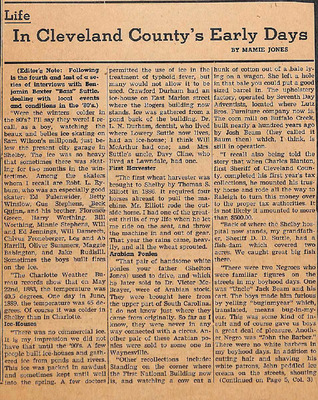
The article describes memories from Benjamin “Bass” Suttle about life in Shelby during the 1880s and 1890s. He recalls ice skating, early ice storage, the arrival of new farm equipment, Arabian ponies, and local businesses and landmarks.
-
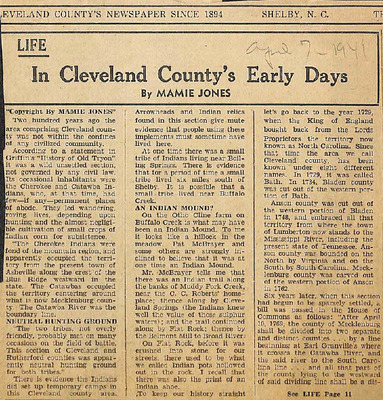
1949, April 7 - Cleveland County Early Days
Mamie Jones
This article describes the early history of the Cleveland County region before permanent settlement, when the Cherokee and Catawba tribes lived in the area. It traces changing colonial boundaries from Bath County (1729) through Bladen, Anson, Mecklenburg, and Tryon counties, explaining how the region was governed before Cleveland County was formed in 1841. The piece discusses early courts, taxation, uprisings, and frontier life.
-
1949, August 10 - Cleveland County Early Days
Mamie Jones
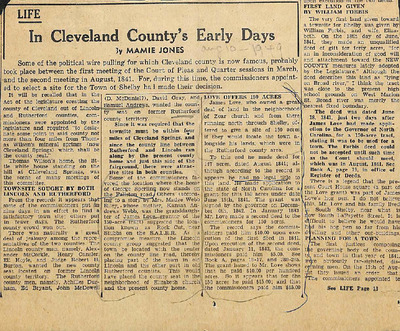
This article explains how the town of Shelby was established in 1841 after Cleveland County was created from Lincoln and Rutherford counties. Commissioners debated locations near Cleveland Springs with land donations from William and Elizabeth Forbes and James Love ultimately determining the site. The piece describes early city planning and layout, as well as early public services and private homes. The article highlights early education, political negotiations, land transactions, and civic planning.
-
1949, August 18 - Cleveland County Early Days
Mamie Jones
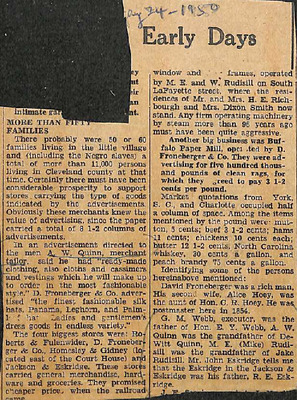
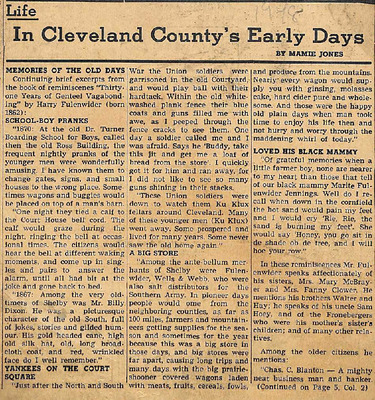
This article shares reminiscences of late 19th century Shelby from Harry Fulenwider’s memoirs, describing school-boy years, local residents, and the time period immediately following the Civil War when Union soldiers were stationed in the county. It highlights several local businesses, places, and persons.
-
1949, December 15 - Cleveland County Early Days
Mamie Jones
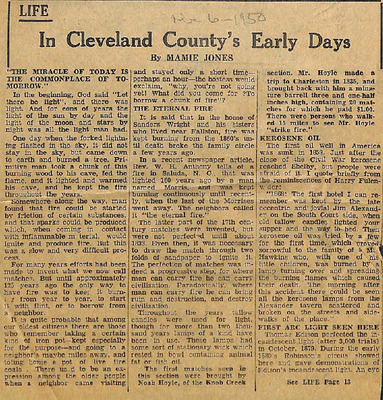
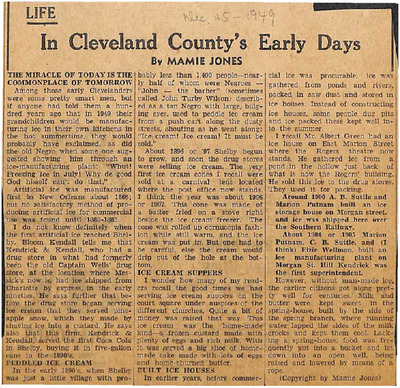
This article describes the evolution of ice production and ice cream culture in Shelby and Cleveland County from the late 1800s into the early 1900s. It recounts early methods of storing natural ice in pits and ice houses, the arrival of shipped ice by rail, and the eventual construction of local ice manufacturing plants. The article also describes community traditions such as church ice cream socials and ice cream shops.
-
1949, December 1 - Cleveland County Early Days
Mamie Jones
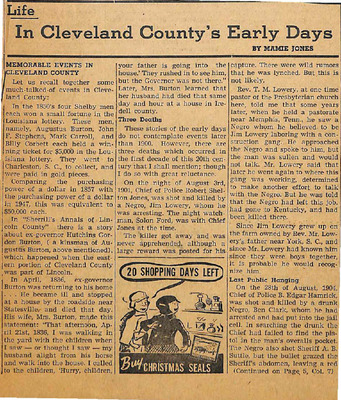
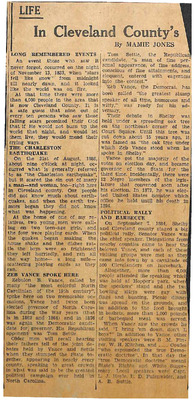
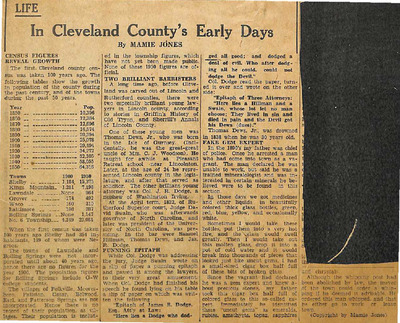
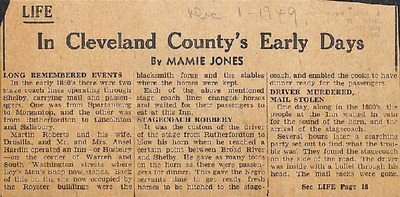
This article recounts notable events in Cleveland County, including stagecoach travel through Shelby in the 1860s, a robbery in which a driver was murdered and mail stolen, and the 1891 Motz murder trial. The trial involved four brothers attempting to kill a man accused of dishonoring their sister but mistakenly killing their cousin instead.
-
1949, March 24 - Cleveland County Early Days
Mamie Jones
This article describes the arrival of the first permanent settlers in what became Cleveland County in 1765, highlighting families such as the Hamrick’s, Blanton's, Greens, and McSwain’s. It explores their migration through Virginia to the region of the county near Boiling Springs and along the Broad River. The narrative details hardships faced by pioneers and frontiersmen of the time period.
-
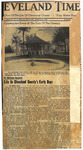
1949, March 4 - Cleveland County Early Days
Mamie Jones
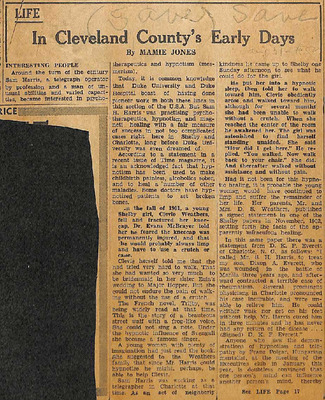
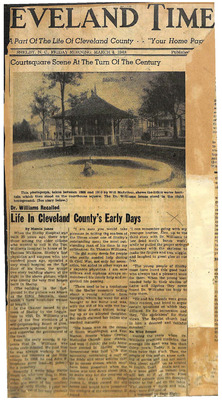
This article recounts life in Cleveland County focusing on Dr. Thomas Williams, Shelby’s first physician. It describes primitive medical knowledge, poor sanitation, and diseases like typhoid fever. The article also describes funeral practices, coffin making, and table manners of the time period.
-
1949, May 20 - Cleveland County Early Days
Mamie Jones
This article lists Revolutionary War soldiers buried in Cleveland County. Local soldiers and families with divided loyalties at the Battle of Kings Mountain include the Goforth, Logan, and Patterson families. Dramatic escapes, battlefield prayers, and the death of Arthur Patterson, Sr are highlighted.
-

1949, May 5 - Cleveland County Early Days
Mamie Jones
This article explains Cleveland County’s origins from Lincoln and Rutherford Counties in 1841, both of whom were formed from Tryon County in 1779. The article describes changes to boundary lines, Township Six, early settlement patterns of Scotch-Irish and Pennsylvania-Dutch settlers, and early communities such as Little Brittian and Westminster.
-
1949, November 16 - Cleveland County Early Days
Mamie Jones
This article describes the Battle of Kings Mountain, October 7, 1780, and it’s impact on the American Revolution. This battle included the Overmountain Men, including notable leaders Frederick Hambright, Isaac Shelby, and Benjamin Cleveland. Men from many local families joined the Overmountain Men in securing the victory which lead to later successes at Cowpens, Guilford Courthouse, and Yorktown.
-
1949, November 24 - Cleveland County Early Days
Mamie Jones
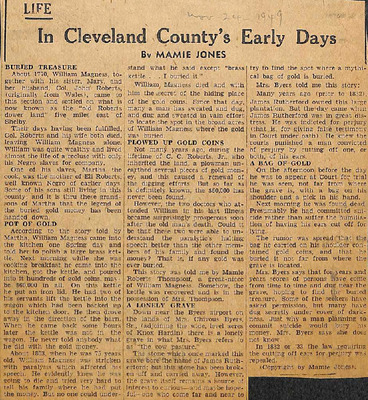
This article describes the legend of a buried treasure in Cleveland County. William Magness, and early settler near Shelby, allegedly buried $60,000 in gold coins in a brass kettle around 1803. Despite later rumors and excavations, the treasure has never been confirmed. The article also includes the story of James Rutherford, who, facing a perjury charge in the 1830s was found dead and allegedly buried with a bad of gold.
-
1949, October 20 - Cleveland County Early Days
Mamie Jones
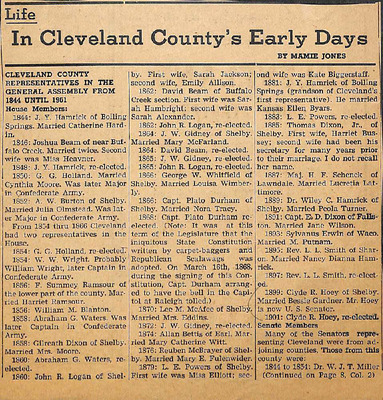
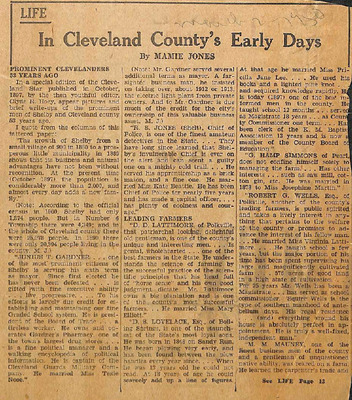
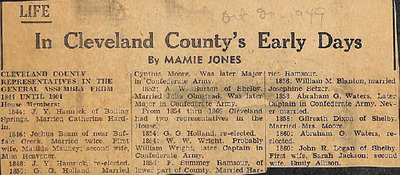
This article lists Cleveland County’s representatives in the North Carolina General Assembly from 1844-1901. It records House and Senate members, their home communities, spouses, and military service. Jones notes occasional record discrepancies and credits P. C. Gardner’s earlier research as her primary source.
-
1949, September 1 - Cleveland County Early Days
Mamie Jones
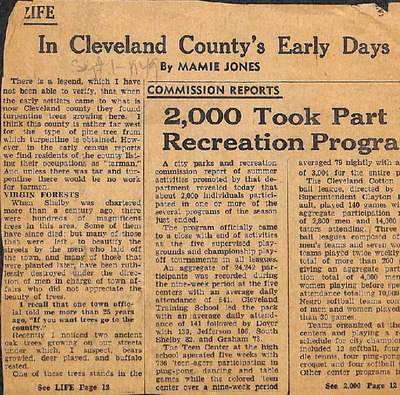
This article reflects on the early history and native plant life of Cleveland County. Included are descriptions of tar production, forest lands, and notable surviving ancient oak trees that predate the Town of Shelby’s founding. The article describes early colonial land grants, wildlife, and Moore’s Deer Park (near Cleveland Springs) owned by Moses Moore.
-
1949, September 6 - Cleveland County Early Days
Mamie Jones
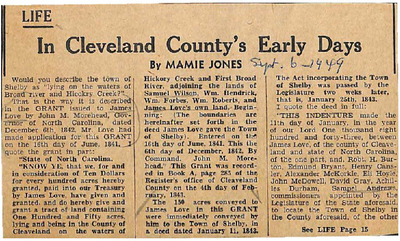
This article describes the founding of Shelby, NC. It centers on an 1842 state land grant of 150 acres to James Love, describing the tract’s boundaries along Hickory Creek and the First Broad River. In January 1843, Love conveyed the land to the county officials for the establishment of the Town of Shelby, including provisions for a courthouse, jail, and six one-acre lots reserved for religious and educational purposes. The article also addresses an earlier 1841 forty-acre gift from William and Elizabeth Forbes.
-
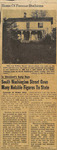
1948, August 10 - Cleveland County Early Days
Mamie Jones
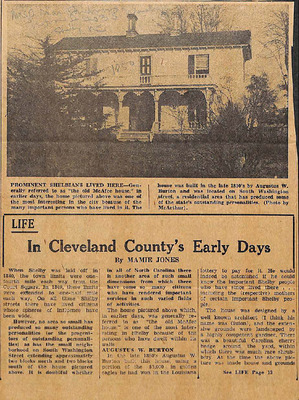
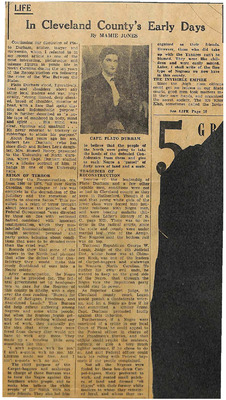
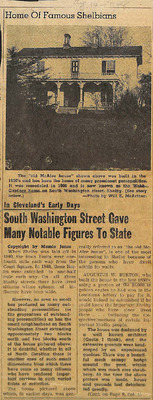
This article highlights notable residents of South Washington Street in Shelby, NC, emphasizing their contributions to politics, religion, business, and culture. It focuses on the historic McAfee (later Webb-Gardner) house and individuals such as Augustus Burton, Clyde Hoey, O. Max Gardner, Edwin Y. Webb, and Tom Dixon. The piece illustrates how this small neighborhood produced governors, judges, preachers, authors, and civic leaders, shaping local and national history.
-
1948 - Cleveland County Early Days
Mamie Jones
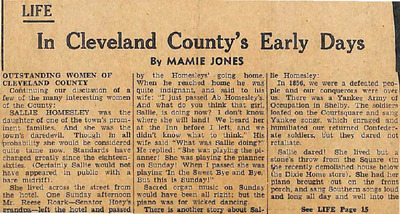
This article shares excerpts from Harry Fulenwider’s memoir, "Thirty-one Years of Genteel Vagabonding," recalling post-Civil War Shelby. He describes his schoolboy years, Union soldiers stationed in town, and merchants' wares in town. He references notable individuals in his life including, Marite Jennings, Mary McBrayer, Fanny Clower, and the Froneberger family.
-
1947, April 18 - Cleveland County Early Days Column
Mamie Jones
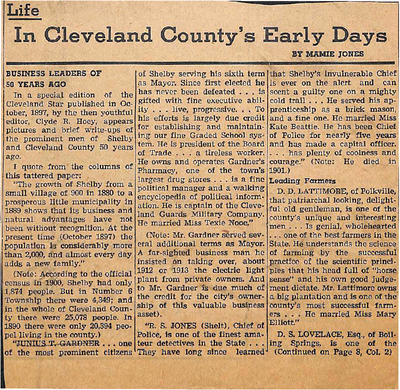
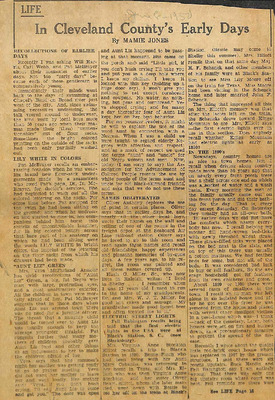
This article, based on an interview with Benjamin Baxter Suttle, recounts life in Cleveland County, NC during the 1880s. It highlights the construction of key buildings, early infrastructure like public wells and tobacco factories, and the growth of Shelby as a commercial hub. The arrival of the Carolina Central Railroad in 1875 further spurred economic activity, making Shelby a center of trade and transportation.
-
1947, April 22 - Cleveland County Early Days
Mamie Jones
This article explores liquor production in early Cleveland County, highlighting homemade beverages, early licensing laws, and taxation. It details resistance to federal excise taxes and the rise of moonshining. Notably, it profiles Amos Owens, a colorful moonshiner from Cherry Mountain who defied tax laws, crafted “cherry bounce,” and outwitted authorities.
-

1947, February 28 - Cleveland County Early Days
Mamie Jones
The article recounts the contributions of Cleveland County pioneers to early American military and civic life. Figures like Martin Roberts served under George Washington, while others, such as James Cook, Willis Weathers, and David Dickey, played key roles in Revolutionary War battles and local governance. The piece also notes early settlers’ migrations, land claims, and burial sites, reflecting the area's foundational history through its notable individuals.
-
1947, March 14 - Cleveland County Early Days
Mamie Jones
The article recounts the role of Cleveland County in key Revolutionary War battles—Ramsour's Mill, Kings Mountain, and Cowpens. It highlights local patriots, especially Col. Frederick Hambright, who was wounded at Kings Mountain but continued leading. Other notable figures include Capt. John Lattimore, Col. Joseph Hardin, and Captains Magness and Espey. It emphasizes the region’s contribution to independence and notes settlers who later fought or settled in the area.