

Mamie Jones’s Cleveland County Early Days newspaper column, originally published in The Shelby Star, documents everyday life, cultural practices, transportation, industry, and notable residents of Cleveland County, North Carolina. The column reflects both documented history and memory-based storytelling, featuring personal recollections, oral traditions, biographies, and accounts of community events.
The clippings in this collection vary in condition; some issues are undated, partially damaged, or incomplete. Articles in the collection reflect the historical context and language conventions of the period in which it was written. Some terminology and descriptions used in the text may be outdated or considered inappropriate by modern standards. These materials are presented for research and educational purposes to preserve the historical record and to support understanding of past perspectives, social conditions, and cultural attitudes.








-
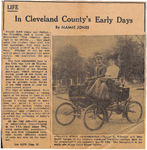
1951, July 18 - Cleveland County Early Days
Mamie Jones
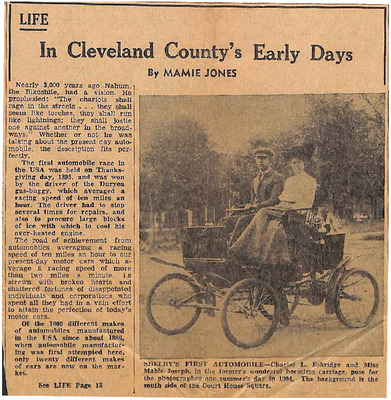
This article traces the arrival and growth of automobiles in Cleveland County, highlighting Shelby’s first car owned by Charles L. Eskridge around 1903–1904 and the gradual adoption of vehicles by local residents. It describes early automobile technology, difficult road conditions, and the novelty of motor travel before paved roads. The article also profiles W. Arthur Pendleton’s financial hardship and eventual recovery through his music business.
-
1951, March 16 - Cleveland County Early Days
Mamie Jones
This article traces the history of early paper manufacturing in Cleveland County, focusing on Samuel R. Oates’s 1851 paper mill on Buffalo Creek near Shelby and earlier mills in nearby Lincoln County. It explains how paper was produced from linen rags, the role of the Froneberger family in financing and operating the mill, and the later involvement of the Tiddy family, whose operations supplied high-quality paper across the region. The article also describes the mill’s decline due to competition from wood-pulp paper and the later development of a cotton mill on the site.
-
1951, May 16 - Cleveland County Early Days
Mamie Jones
This article explores women’s work and fashion in Cleveland County from the early 1800s through the early 20th century. It describes how women produced clothing entirely by hand—spinning, weaving, dyeing, and sewing—before manufactured textiles and sewing machines became common. Later sections examine millinery and dressmaking businesses in Shelby, changing clothing styles from hoop skirts to early modern fashions, and shifting social expectations about modesty and appearance. Anecdotes illustrate daily labor, cultural attitudes, and evolving trends, showing how women’s roles and fashion reflected broader economic and social changes over time.
-
1951, May 31 - Cleveland County Early Days
Mamie Jones
This article recounts an 1840s traveling wax-figure show near Shelby whose performers disappeared and were later believed to have been murdered, with skeletal remains eventually discovered near a Broad River bridge. It also describes early covered bridges in Cleveland County, including one washed away by flooding in the 1860s, and the later construction of low and iron bridges through state funding efforts. Additional sections highlight unusual wills and funeral instructions from historical county records, offering insight into beliefs, infrastructure, and community life in 19th-century Cleveland County.
-
1951, May 3 - Cleveland County Early Days
Mamie Jones
This article describes Cleveland County’s establishment of wardens to care for the poor, the creation of the county poorhouse and farm in 1847, and the practice of “binding out” orphaned or dependent children as apprentices. Later sections compare past and present (1950s) approaches to welfare, funerals, and household customs, including coffin-making, food preparation, and health beliefs.
-
1951, November 14 - Cleveland County Early Days
Mamie Jones
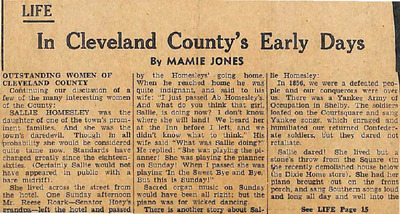
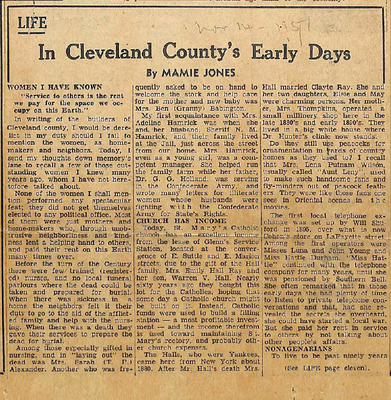
This article highlights women of Cleveland County who provided nursing, midwifery, and funeral preparation before professional services were common, emphasizing figures such as Mrs. Sarah Alexander and Mrs. Ben Babington. The narrative also recounts Adeline Hamrick’s management abilities during the Civil War era, the Hall family’s contributions to St. Mary’s Catholic Church through a land gift, and early telephone operators in Shelby.
-
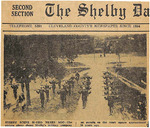
1850, October 19 - Cleveland County Early Days
Mamie Jones
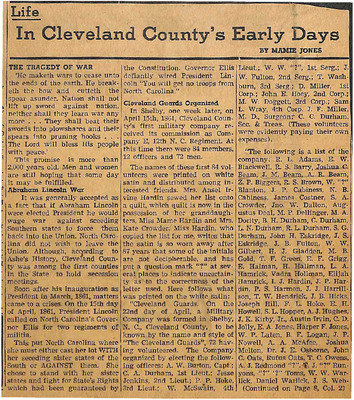
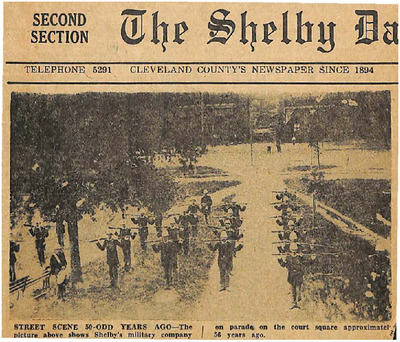
This article describes the history of the reorganization of the Cleveland Guards regiment in 1875 as part of the North Carolina state militia participating in the Spanish-American War. The article also describes local sites in Shelby, installation of gasoline street lamps, businesses, and social events.
-
1950, April 20 - Cleveland County Early Days
Mamie Jones
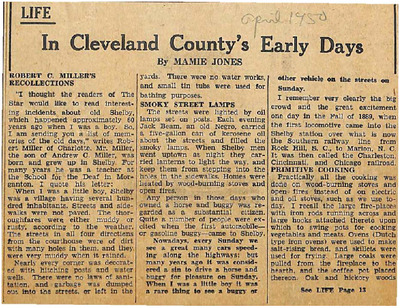
This article presents Robert C. Miller’s childhood memories of Shelby in the late 1800s, describing unpaved streets, poor sanitation, kerosene street lamps, and homes heated by wood fires. It recalls the arrival of the first train in 1889, primitive cooking methods, and everyday challenges such as flies and limited household technology. Later sections describe social life, including sports, church gatherings, cycling, and excursions to Cleveland Springs.
-
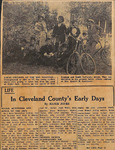
1950, August 10 - Cleveland County Early Days
Mamie Jones
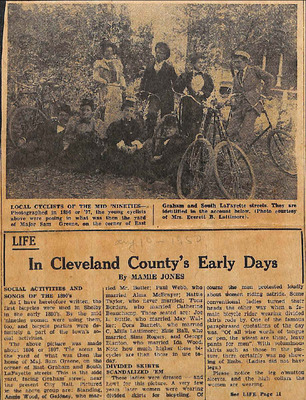
This article describes social life and recreation in Shelby during the 1890s, focusing on bicycle clubs, straw rides, dances, and popular music of the era. It includes a photograph of local cyclists taken around 1896–1897 at Major Sam Greene’s home near East Graham and South Lafayette streets. The article describes community attitudes toward dancing, including church opposition and later acceptance, along with memories of orchestras, popular songs, and social gatherings at local springs.
-
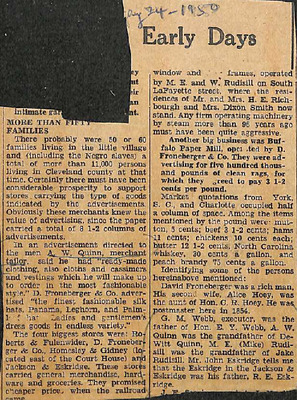
1950, August 24 - Cleveland County Early Days
Mamie Jones
This article describes commercial life in early Shelby, when about 50–60 families lived in town within a county population exceeding 11,000. It highlights local merchants, advertisements, and major stores such as Roberts & Fulenwider, D. Froneberger & Co., Homesley & Gidney, and Jackson & Eskridge, showing the range of goods available before the railroad arrived. The piece also references early manufacturing, including a steam-powered sash and blind factory and the Buffalo Paper Mill, along with market prices for food and goods. Biographical notes identify prominent business figures and their family connections.
-
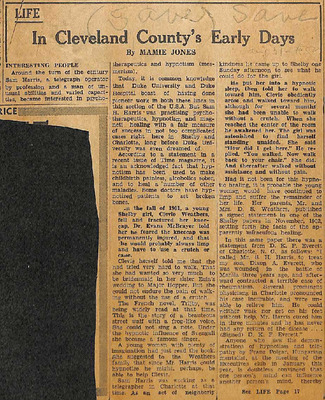
1950, August 31 - Cleveland County Early Days
Mamie Jones
This article profiles Sam Harris, a Shelby telegraph operator who practiced hypnotism, magnetic healing, and psychotherapy around the turn of the 20th century, including a widely discussed case in which a young woman reportedly regained the ability to walk. It also highlights his father, John F. Harris, an early telegraph operator and merchant, and shares anecdotes about his strength and business activities. Later sections reference early Shelby newspapers, escaped prisoners, and local publications.
-
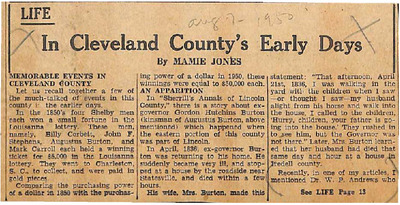
1950, August 7 - Cleveland County Early Days
Mamie Jones
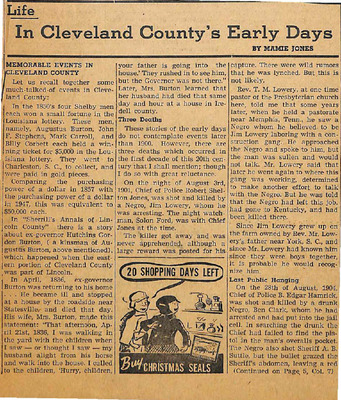
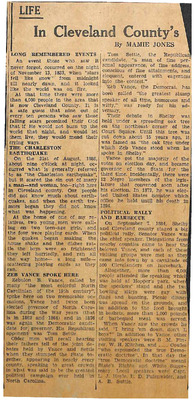
This article recounts several memorable events in Cleveland County history from the 1800s through the early 1900s. It includes stories of Shelby residents winning the Louisiana lottery in the 1850s, a reported apparition connected to Governor Burton’s death, and a remarkable abdominal surgery performed in the 1880s by local physicians. Later sections describe violent incidents, including the killings of police chiefs in 1901 and 1904, the county’s last public hanging, and a mysterious roadside confrontation in 1909 involving Dr. T. F. McBrayer.
-
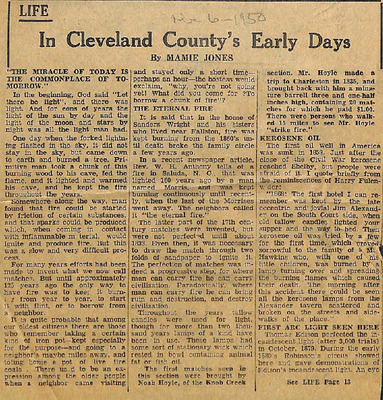
1950, December 6 - Cleveland County Early Days
Mamie Jones
This article traces the evolution of lighting and public utilities in Shelby and Cleveland County from early fire-starting methods and candles to kerosene lamps, electric lights, and city infrastructure. It recounts community memories of borrowing fire, early matches, and fears of kerosene accidents, then describes the arrival of electric lighting around 1900, including generators at local mills and the city’s purchase of the electric plant in 1912. Later sections highlight early bicycles, sidewalk paving, and waterworks improvements.
-
1950, February 9 - Cleveland County Early Days
Mamie Jones
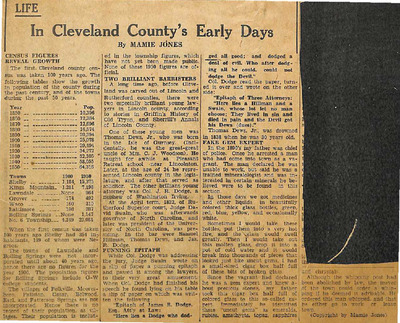
This article explains why Shelby did not secure the main line of the Southern Railway in the mid-1800s. It argues that local leaders were not necessarily short-sighted but faced severe financial constraints, war-related economic decline, and existing debt from investments in the Wilmington, Charlotte & Rutherford Railroad. Census data and county records show limited resources and difficulty paying bond interest after the Civil War. The railroad ultimately followed a different route through Kings Mountain and Grover, though Shelby later gained a branch line in 1889.
-
1950, January 19 - Cleveland County Early Days
Mamie Jones
This article profiles two influential early Baptist ministers in the Cleveland and Rutherford County region—Rev. Drury Dobbins and Rev. James M. Webb. It describes their preaching ministries in the early 1800s, their association with Hardshell (Predestinarian) Baptist traditions, and their roles in establishing churches such as Shelby’s First Baptist Church. Anecdotes about Dobbins’ humility, personal life, and reputation illustrate frontier religious culture, while accounts of Webb’s powerful preaching highlight his regional influence.
-
1950, July 20 - Cleveland County Early Days
Mamie Jones
This article continues Benjamin Baxter Suttle’s recollections of Shelby in the 1880s–1890s, describing early brick buildings, population growth, and a business boom around 1884. It details public wells on the courthouse square, construction methods before modern utilities, and the prominence of tobacco manufacturing, including local factories, sales barns, and regional trade. The narrative also explains how the arrival of the Carolina Central Railroad transformed Shelby into a cotton trading center, with wagons lined from the courthouse to the depot. Overall, the piece illustrates economic development, industry shifts from tobacco to cotton, and the town’s emergence as a commercial hub.
-
1950, July 27 - Cleveland County Early Days
Mamie Jones
This article continues Benjamin Baxter “Bass” Suttle’s recollections of late 1800s Shelby and Cleveland County, describing winter ice skating, early ice storage, and the introduction of new farm technology such as the first wheat harvester. It recounts local businesses, Arabian ponies, and community figures like John-the-barber, while also explaining the lively “first Monday” sales and trading days when rural residents gathered in town to buy, sell, and socialize. Later sections reflect on changing transportation, roads, and community development.
-
1950, June 8 - Cleveland County Early Days
Mamie Jones
This article shares personal recollections of everyday life in Shelby and Cleveland County in the late 19th and early 20th centuries. It includes memories of childhood swimming at Chapel’s Bend on the Broad River, handmade clothing from flour sacks, and colorful community figures such as “Aunt Liz” Green. The narrative also describes early electric lighting trips to Black’s Station, rural home routines before modern plumbing, smallpox outbreaks, and the old courthouse used for meetings, schools, and spelling matches.
-
1950, March 2 - Cleveland County Early Days
Mamie Jones
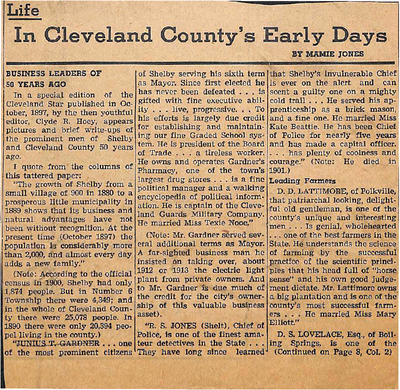
This article highlights prominent citizens of Shelby and Cleveland County as profiled in an 1897 special edition of The Cleveland Star. It describes community leaders such as Mayor Junius T. Gardner, Police Chief R. S. Jones, and several influential farmers and businessmen, emphasizing their achievements, civic involvement, and economic contributions.
-
1950, May 10 - Cleveland County Early Days
Mamie Jones
This article highlights notable graves and memorials connected to Cleveland County history, including Revolutionary War leaders Col. William Graham and Col. Frederick Hambright. It also describes monuments in Shelby’s Sunset Cemetery, including those of Jesse Jenkins, author Thomas Dixon Jr., and Governor O. Max Gardner. Additional references to Union soldiers’ graves illustrate post–Civil War tensions and local memory.
-
1950, May 25 - Cleveland County Early Days
Mamie Jones
This article traces the introduction of telephone technology to Shelby and Cleveland County in the late 19th century. It describes the first local connections between Dr. Victor McBrayer’s home and drugstore, the establishment of Shelby’s first telephone exchange around 1895, and early operators and equipment. The narrative also recounts the county’s first long-distance call between Shelby and Double Shoals, illustrating how unfamiliar residents were with the new technology.
-
1950, May 4 - Cleveland County Early Days
Mamie Jones
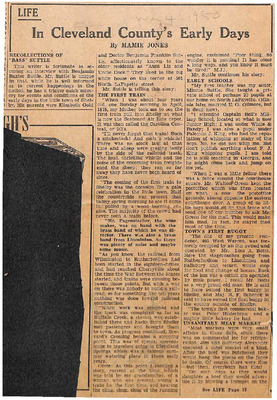
This article presents recollections of Benjamin Baxter “Bass” Suttle about life in Shelby from the 1870s through the 1880s. He describes the arrival of the first train in 1875, early schools and teachers, stagecoach travel, local businesses, wages, and everyday conditions such as roaming livestock due to the absence of stock laws. Memories also include the 1886 earthquake and the development of regional railroads.
-
1950, November 2 - Cleveland County Early Days
Mamie Jones
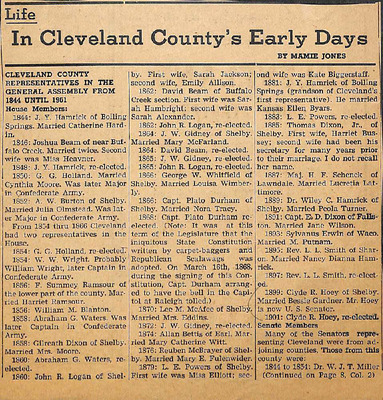
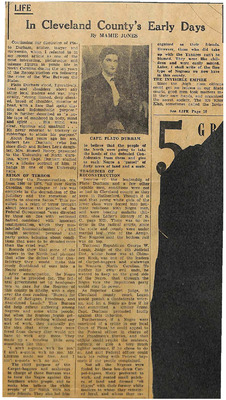
This article includes a biography of Captain Plato Durham and his leadership roles in Cleveland County during the Reconstruction period following the Civil War. It describes the political instability of the time, racial tensions, the Freedmen’s Bureau, and the influence of Judge George W. Logan. The article discusses the activities of the Ku Klux Klan in the county and region during the time period.
-
1950, October 5 - Cleveland County Early Days
Mamie Jones
This article examines the intense 1894 political conflict in Cleveland County between Democrats and Populist-Republicans. It describes disputed election results, lawsuits over vote counts, and eventual victory of Jacob H. Quinn for clerk of court. The piece explains the origins of the Populist Party in the Farmers Alliance, economic hardships facing farmers, and broader state/national politics of the time.
-
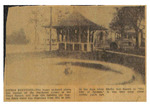
1950, September 1 - Cleveland County Early Days
Mamie Jones
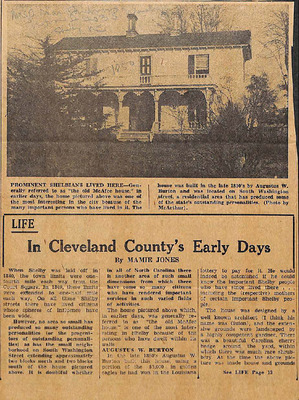
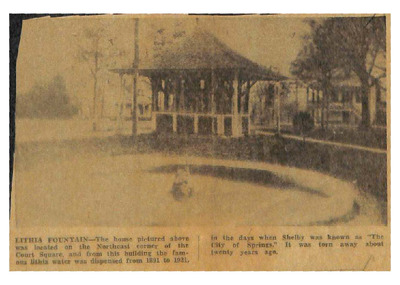
This article describes Shelby’s history as the “City of Springs,” focusing on the development of the lithia water fountain supplied from a mineral spring north of town in the 1890s. It explains how civic leaders financed piping the water to the courthouse square, its popularity for healing properties, and the role of Crawford Durham and the Shelby Land & Improvement Company.