


Instructional Modules for Professional learning Responding to Opportunities and Valuing Educators (IMPROVE) is a peer-reviewed virtual professional development resource. Modules within the resource are collaboratively authored by candidates in their final semester of coursework in the EdD in Curriculum & Instruction at Gardner-Webb University and promote positive, data-informed, sustainable change in instructional practices or organizational structures to improve student learning at the K-12 level and beyond.
The learning cycle featured in the modules in this resource is based on the STAR Legacy Cycle developed by the IRIS Center (2013); http://iris.peabody.vanderbilt.edu/) and based on the work of Dr. John Branford and colleagues (National Research Council, 2000).























-

Don't Forget Your Parachute: Using the UBD Framework to Guide Unit Planning
Angela Hines and Nicole Ludwa
The audience for this module includes educators at all levels of all subject matters. This module is designed for educators interested in increasing student understanding and in creating more effective curricula and assessment through unit planning, beginning with the end in mind. Thinking about what to teach and how to teach it is a matter of habit, thinking about the learning outcomes leads to appropriate teaching and is how backwards planning works. Lessons should be created by the results sought, not the activities with which a teacher is most comfortable. Many times teachers are focused on the inputs rather than the outputs of a lesson, which means the focus is on teaching, not learning. Explanations and numerous examples of backwards planning through the Understanding By Design Framework are provided.
-

Mentoring Relationships
Tori Hill, Lori Nanney, Kimberly Perry, and Amanda Edwards Whatley
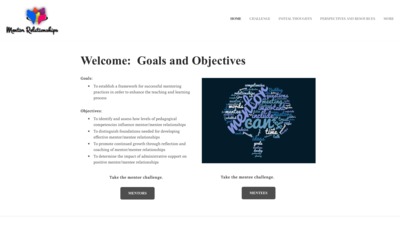
The purpose of this module is to establish a framework for successful mentoring practices in order to enhance the teaching and learning process. The module addresses the importance of the Four Pillars as a framework for building successful mentor/mentee relationships. The framework pillars are identified as pedagogical competencies,relationship building, reflection, and administrative support. Each pillar is defined with research provided to support the importance of each as a foundational element of successful mentor/mentee relationships. Additionally the module provides reflection activities and additional resources for consideration and site-level implementation.
The learning module is intended for use by all educators.
-
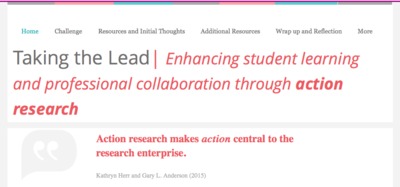
Teachers As Leaders: Action Research in the Classroom
Teresa Lester and Stephanie McCabe
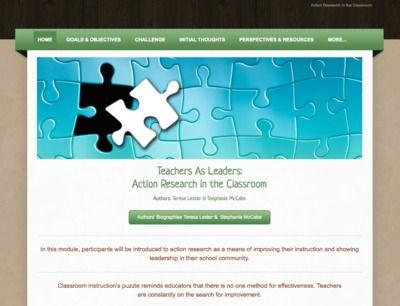
The purpose of this module is to explore means in which teacher leaders can utilize the process of action research to improve outcomes for students. Participants who utilize this module will learn the "habits of mind" --assessing performance, analyzing problems they encounter in the classroom, prescribing an intervention, monitoring performance, learning from experience (Sagor, 2000) --to continue the work of professional educators. Additionally, the use of action research as professional development assures teacher leaders and school administrations that their teachers will use new knowledge for the pursuit of effective strategies for student learning.
-

What if I can't PLC?
Lindsay Lee, Audrey Moore, Angela Szakasits, and Cynthia Wortham
The purpose of this learning module is to provide information for teachers and administrators to learn ways to overcome barriers to participate in PLCs. The goal of this learning module is to provide teachers and administrators with resources to employ facilitation skills, create trust among colleagues, develop collective wisdom, build ownership, and take action to support student learning.
-

Facilitating Equitable Classrooms
Sara Arndt and April Guenzler
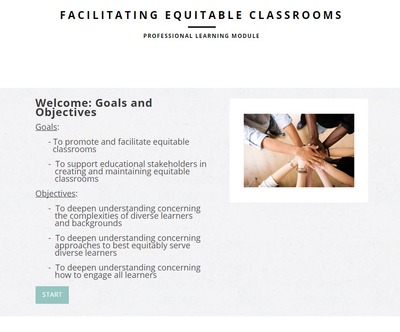
Public education serves all students and works to close the achievement gap currently present in our society. This module aims to help assist educational stakeholders best support all students through differentiation and best practices. Most of the suggestions and strategies can work in any classroom environment. At the core of this module, however, one must understand that respect is essential between all stakeholders especially teachers and students to have an effective classroom community.
-

Increasing Student Outcomes Through Effective Feedback
Julie Conn, Michelle Bennett, Cari Maneen, and Terree Andrew
This module explores descriptive purposeful feedback and its use as a strategy for differentiation and as a formative assessment tool. This module explores in detail research integral to understanding what effective and purposeful feedback is and the importance of providing specific and descriptive feedback. This module provides an evaluator the understanding and tools for how to use purposeful feedback to determine if a student is meeting the established performance criteria or if more intensive intervention is needed.
-

Our Collaborative Team
Roberta Callaway, LaVerne Chestnut, and Jeffery Waters
This module is designed to help you recharge your knowledge about PLCs and refine your understanding of how a PLC team can function more effectively. As teachers collaborate in PLC meetings, a culture of commitment, willingness to change, and accountability emerges as instructional leaders develop common assessments, study data, and create opportunities for higher levels of student achievement. An effectively functioning team can lay the groundwork for tackling challenges and embracing the rewards of student learning success.